Ask any Lake Anna listing agent what buyers get wrong most often and the answer is rarely the price. It's the assumption that a warmer side of the lake means a more expensive side of the lake. That single mental shortcut, repeated across enough showings, is why so many buyers end up surprised twice: once when they realize the "premium" side has no public boat ramp at all, and again when they compare their tax bill to a neighbor three coves away who paid less for a bigger house.
Lake Anna looks like one lake on a map. It behaves like three separate markets stacked on top of each other, and almost none of the marketing language buyers read before they tour a property mentions more than one of those lines.
The Dike Line: Two Bodies of Water Wearing One Name
Lake Anna exists because Dominion Energy built it in the early 1970s to cool the North Anna Power Station. Three rock dikes physically separate the lake into two sections. The larger section, roughly 9,400 to 9,600 acres, is open to the public and carries the marinas, restaurants, and the boat traffic that comes with both. The smaller section, the private side, is technically the plant's waste heat treatment facility, three interconnected cooling lagoons covering roughly 3,400 to 4,000 acres.
Water that passes through the plant returns to the private side warmer than it started, typically by around 14 degrees Fahrenheit compared to the public side. That temperature gap is real and it does what buyers expect: it extends the swimming and boating season on the private side well past what most Virginia lakes offer in a given year.
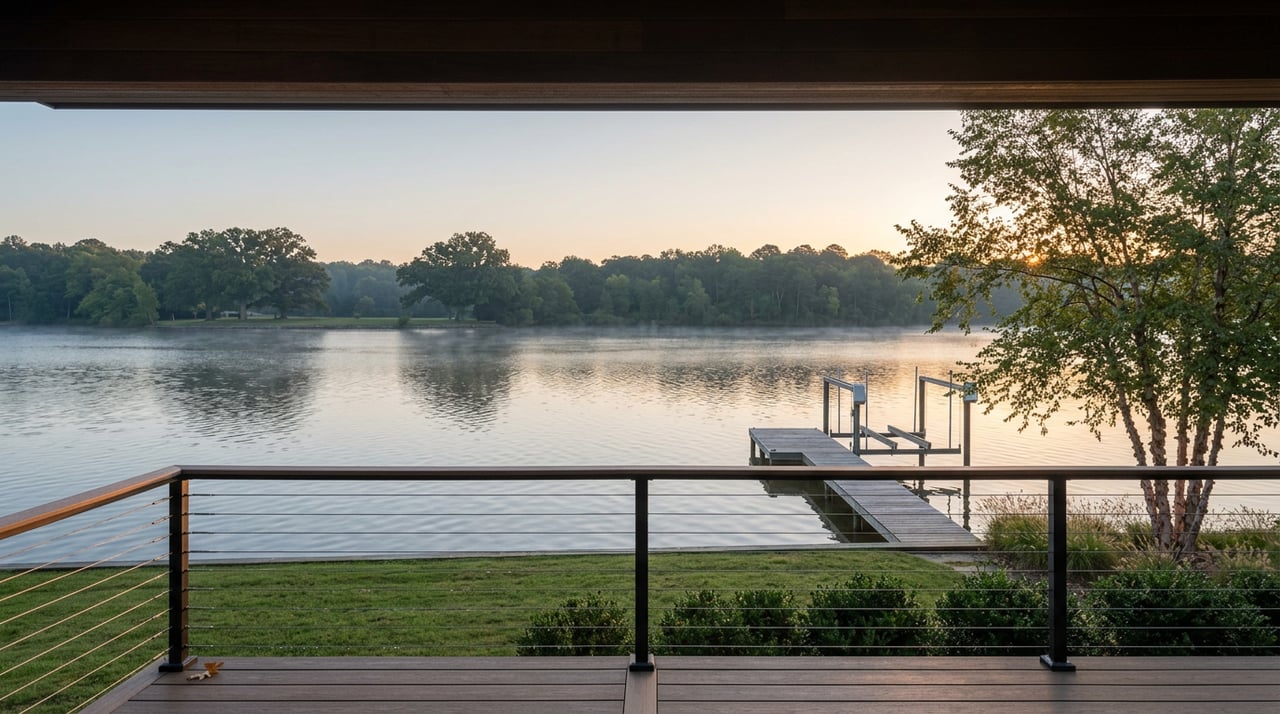
What most buyers don't expect is that the private side has no public boat ramp. Access belongs to property owners and their guests. If you don't own on that side, or know someone who does, you can't launch a boat there, full stop. That's not a lifestyle preference. It's a legal access line, and it means the two sides of Lake Anna aren't a budget option and a luxury option of the same product. They're two different products that happen to share a shoreline and a name.
What the Comparison Actually Looks Like
| Public Side (Cold) | Private Side (Warm) | |
|---|---|---|
| Boat access | Open, public ramps | Owners and guests only |
| Water temperature | Baseline lake temperature | Roughly 14°F warmer, longer season |
| Commercial amenities | Marinas, restaurants, Lake Anna State Park | None, quieter by design |
| Boat traffic | Heavier, especially summer weekends | Lighter, no commercial operation allowed |
Neither column is objectively better. A buyer chasing short-term rental income wants the public side's restaurants and marinas nearby, because that infrastructure is part of what makes a listing rentable in the first place. A buyer who wants a quiet dock with a nine-month swim season and doesn't care about boating to dinner is better served on the private side, provided they confirm ahead of time whether their specific subdivision includes shared water access, since not every private-side community offers the same slip or ramp arrangement.
The County Line You Can't See From the Water
Lake Anna sits across three counties: Louisa, Orange, and Spotsylvania. That boundary has nothing to do with which side of the dike a house sits on, and everything to do with what a buyer pays every year after closing. Louisa carries the lowest property tax rate of the three counties touching the lake. Spotsylvania, meanwhile, layers on a 1 percent short-term rental tax in addition to standard transient occupancy taxes, which typically run around 5 percent for lake rentals across the region.
That means two nearly identical houses, same side of the dike, same cove, same view, can carry different annual costs simply because a county line runs between them. It's the kind of detail a listing sheet never surfaces and a buyer touring on a Saturday has no way to see. It shows up only when you ask which county a specific parcel sits in and then check that county's current rate and any short-term rental ordinance before you get attached to a number in your head.
The North-South Line Nobody Talks About at the Showing
There's a third line, and it runs the length of the lake rather than across it. The south end of Lake Anna is deeper and clearer, with wider open water and panoramic views, and it commands higher prices. The north end, closer to Route 522 toward Culpeper, tends to be shallower and can run muddier, particularly near the tributaries where the North Anna River, Pamunkey Creek, and Terry's Run feed into the lake.
That geography matters for a reason beyond aesthetics. The Lake Anna Civic Association's water quality monitoring, done in partnership with the Virginia Department of Environmental Quality, has documented harmful algae bloom activity concentrated in those same upper-lake tributary areas for years. In 2025, the Virginia Department of Health changed how it issues recreational advisories for the lake, moving from measuring algae cell counts to measuring the actual toxins those algae produce, a shift meant to reduce false-positive advisories while keeping the public informed when toxins are genuinely present. The Civic Association has also run a pilot algaecide treatment program targeting specific coves, including areas of the upper Pamunkey Branch and the Duckinghole and Goldmine Creek areas, aimed at reducing the no-swim advisories that have historically clustered there.
None of this means the north end is off limits. It means the water quality conversation at Lake Anna is cove-specific, not lake-wide, and it runs independently of the warm-cold divide. A buyer could land on the private, warm side of the lake and still be in a cove with a documented HAB history if that cove happens to sit in the upper lake region. The only way to know is to ask which Area of Interest a specific cove falls into, something the Civic Association tracks and publishes.
What the Money Buys Once You Sort the Lines
With those three lines in mind, the price data actually makes more sense. Waterfront homes at Lake Anna are priced primarily on shoreline length and the size of the water view, not square footage, which is why a smaller home with excellent frontage regularly outsells a larger home with a narrow lot. Entry-level waterfront has generally run from about $750,000 to $1.2 million, mid-range waterfront from $1.2 million to $1.6 million, and high-end estates from $1.6 million up past $3 million, based on 2025 and early 2026 market reporting. Water-access homes, which sit near the lake without touching the shoreline, have typically ranged from around $300,000 to $750,000, with new construction priced according to builder and finish level.
The lake closed 2025 with 242 total home sales, down slightly from 262 in 2024, alongside a record high-end sale of $4.4 million in 2025, up from a top sale of $3.4 million the year before at Noah's Landing on the private side. That combination, slightly fewer transactions but a higher ceiling at the top, is consistent with a market where buyers have become more selective about exactly which lines they're buying into rather than simply chasing "lakefront" as a category.
Entering 2026, market reporting showed inventory at roughly 81 homes for sale, split between 36 waterfront and 45 lake-access listings, with prices spanning from about $348,000 to $4.799 million. By summer 2026, agents working the lake described the buyer pool as more patient and more informed than in prior years, with the most active price bands falling between $500,000 and $900,000 for second-home and remote-work buyers, and $900,000 to $1.5 million for high-end second homes and downsizing retirees. That patience tracks with everything above. A buyer who understands the dike line, the county line, and the north-south line is negotiating from a very different position than one who is simply comparing photos of docks.
What This Means If You're Comparing Sides
If short-term rental income is the goal, the public side's proximity to marinas and restaurants supports the kind of rental demand that made the broader Lake Anna area, and Mineral in particular, one of Virginia's stronger vacation rental markets in recent years. Confirm your county's short-term rental ordinance and tax structure before you build a rental projection, since Louisa and Spotsylvania regulate differently.
If quiet and a longer swim season matter more than boating to dinner, the private side delivers, but confirm your specific subdivision's water access before you assume anything. Not every warm-side community includes a shared ramp or slip.
If carrying costs matter as much as purchase price, ask which county a listing sits in before you compare it to a similar house across the lake. The tax difference is real and it compounds every year you own the property.
If you're looking north of the Route 208 bridge, ask about that specific cove's water quality history. Advisories at Lake Anna are local to the cove, not lake-wide, and the Civic Association's water quality data is public.
None of these lines shows up on a portal search filter. They show up when someone who actually works this market walks a property with you and asks the right questions before you write an offer.
Ready to Sort Through Lake Anna's Lines With Someone Who Knows Them
Lake Anna rewards buyers who understand its geography, not just its listings. If you're weighing which side, which county, and which cove makes sense for how you actually plan to use the water, Michelle Nicely can walk you through the trade-offs specific to Louisa County before you make an offer. Let's Connect — Start Your Stress-Free Move.